Anacondas are important to the Amazonian ecosystem because they act as apex predators and herl maintain the balance of other animal populations.
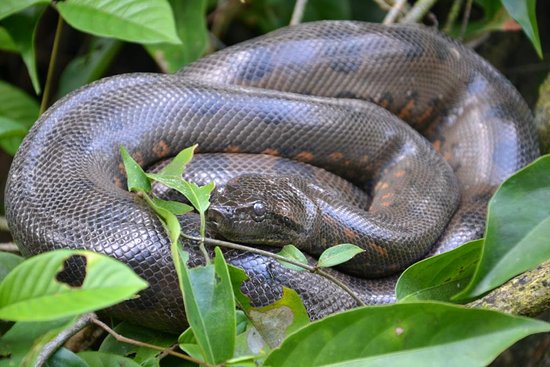
Anacondas are among the largest predators in South America’s tropical ecosystems. In the Ecuadorian Amazon, the green anaconda (Eunectes murinus) is primarily associated with slow-moving rivers, lagoons, and swamps

One of their most important ecological functions is acting as predators.
Anacondas can feed on various animals, depending on their size and the habitat in which they live. Their prey may include:
- Fish
- Turtles and other reptiles
- Young caimans
- Mammals
- Capybaras and other large animals
Their presence is valuable for scientific research.
Anacondas are also important for studying:
- The functioning of tropical ecosystems.
- Predator-prey relationships.
- The biodiversity of Amazonian wetlands.
- The adaptation of large reptiles to aquatic environments.
- The effects of environmental changes on wildlife.
Studying these species helps scientists better understand how Amazonian ecosystems function.


It is not simply a “dangerous snake.”
The green anaconda often inspires fear due to its enormous size, strength, and appearance. However, simply describing it as a “dangerous snake” is an oversimplification of its behavior and its role in nature.
Anacondas are predators, not animals that hunt humans. Their behavior revolves primarily around finding food, reproducing, resting, and avoiding threats. As with many wild animals, an anaconda may defend itself if it feels threatened, cornered, or handled, but this is very different from actively seeking out people to attack.

It is an extraordinary example of adaptation.
Its body is perfectly adapted to its environment:
- Its eyes and nostrils are located on the top of its head, allowing it to observe and breathe while keeping most of its body underwater.
- Its muscular body enables it to move and capture prey.
- It can remain in aquatic environments for long periods.
- It uses its body strength to subdue prey through constriction.
These adaptations explain why the anaconda can occupy an ecological niche that other predators cannot exploit in the same way.
The Anaconda as a Connection Between Worlds
One of the most interesting interpretations views it as a liminal being—that is, a creature associated with spaces that connect different realities.
The anaconda inhabits an environment where the boundaries between water and land virtually disappear. From a symbolic perspective, this can be linked to the idea of a connection between different worlds.
This interpretation aligns perfectly with an article discussing «rivers and legends,» as it allows the Amazon to be presented not merely as a place of biodiversity, but also as a territory rich in cultural significance.
The anaconda as a being linked to origin and creation
In various Amazonian traditions, large snakes appear associated with the origins of peoples, rivers, and the territory.
The snake can represent an ancestral force that connects different realms of the world: water, land, the rainforest, and the spiritual world.
In some traditions, large snakes are depicted as ancestral beings linked to the birth of rivers or the establishment of the territories inhabited by these peoples.